AI is taking over European startup funding: What founders need to know


European startup funding has entered its AI era.
In 2026, AI startups attracted an unprecedented amount of venture capital, with US$23 billion invested in European AI companies during the first half of the year. AI alone represented 55% of all European venture funding, showing that investors are placing some very serious bets on artificial intelligence. (The European; AI Magazine; AFP)
But the story is not only about how much money is flowing into AI. It is also about which companies are receiving it, why AI has become Europe’s hottest startup sector, and what this means for future founders.
This article explores the rise of AI investment in Europe, the challenges behind the funding boom, and where opportunities exist for early-stage founders, startup entrepreneurs, and innovators building the next generation of startups.
Key takeaways
- AI startups attracted US$23 billion in European venture funding in H1 2026.
- AI represented more than half of all European startup investment.
- Funding is concentrated among a small number of companies.
- Europe’s opportunity may lie in applying AI to existing industrial strengths.
- Founders do not need to build the next ChatGPT, but rather they need to solve valuable problems.
Why AI is attracting so much investment
AI is attracting record investment because it is proving its value across industries and creating new opportunities to solve real-world problems.
The growth of AI funding in Europe has been dramatic. Between January and June 2026, European AI startups raised US$23 billion, more than double the amount raised during the same period the year before. (The European; AI Magazine; AFP)
Investors are increasingly interested in AI because the technology is moving beyond experimentation and into practical applications. Europe’s strengths in areas such as manufacturing, healthcare, robotics, and engineering create opportunities for startups using AI to improve existing industries. (The European; AI Magazine; Ifri)
Europe’s AI opportunity does not necessarily look like Silicon Valley. Instead of only competing to build massive foundation models, European startups may have an advantage by applying AI to real-world problems where they already have expertise. (Ifri)
Where is the EU funding money going
Raising funding stays competitive because investors are concentrating their investments on startups with strong growth potential.
Although AI funding is booming, it is not being distributed evenly.
A large share of investment is concentrated among a small number of companies. In H1 2026, 73% of European AI funding went to only 38 companies, with several startups raising more than US$1 billion. (The European; AI Magazine; AFP)
This means the AI funding boom does not automatically make fundraising easier for every startup. Investors are making larger bets on companies that already show strong potential for scale.
For early-stage founders, this makes the basics even more important:
- A clear problem to solve – show that you're addressing a real customer need.
- Strong execution –deliver on milestones, show consistent progress, and turn ideas into action.
- Customer validation – gather evidence that people actually want your solution through interviews, testing, and feedback.
- The ability to grow – prove your business model has the potential to grow sustainably over time.
What is Europe’s AI funding map
The UK currently leads Europe’s AI funding landscape, attracting around US$12 billion in H1 2026. Germany followed with US$3.5 billion and France with US$2.9 billion. (The European; AI Magazine; AFP)
Other European ecosystems are also growing. The Netherlands, for example, has seen major AI investments, including significant funding rounds for companies developing advanced AI technologies. (AI Magazine)
However, Europe’s challenge is not only creating startups. It is ensuring companies can access the capital, infrastructure, talent, and computing power needed to scale globally.
Why is competing with Big Tech a challenge
Competing directly with Big Tech is difficult, but Europe has an opportunity to stand out by building specialised AI solutions for industries where it already has strong expertise.
Despite strong investment growth, Europe still depends heavily on global technology companies for parts of the AI ecosystem, including cloud infrastructure, computing resources, and major AI platforms. (Ifri)
Nevertheless, Europe does not necessarily need to compete directly with Big Tech. Instead, its opportunity may be in building specialised AI applications for industries where Europe already has strong knowledge and capabilities. (Ifri)
The future may not belong only to companies building the biggest AI models. It may also belong to startups using AI to make factories smarter, healthcare better, logistics faster, and everyday systems more efficient.
Basically: you do not always need to build the engine. Sometimes you build the car that everyone actually wants to drive.
What Europe is doing to support AI startups
The European Commission is working to strengthen Europe’s AI ecosystem by improving access to funding, infrastructure, talent, and computing power.
Initiatives such as AI Factories and planned AI Gigafactories aim to provide researchers, startups, and companies with better access to the resources needed to develop advanced AI solutions. (European Commission)
The goal is not only to create more AI startups but to help European companies grow and compete internationally. (European Commission)
What AI funding means for founders
For entrepreneurs, the AI boom creates huge opportunities—but also higher expectations.
Adding “AI” to a startup idea is not enough. Investors are looking for companies that solve real problems and create measurable value.
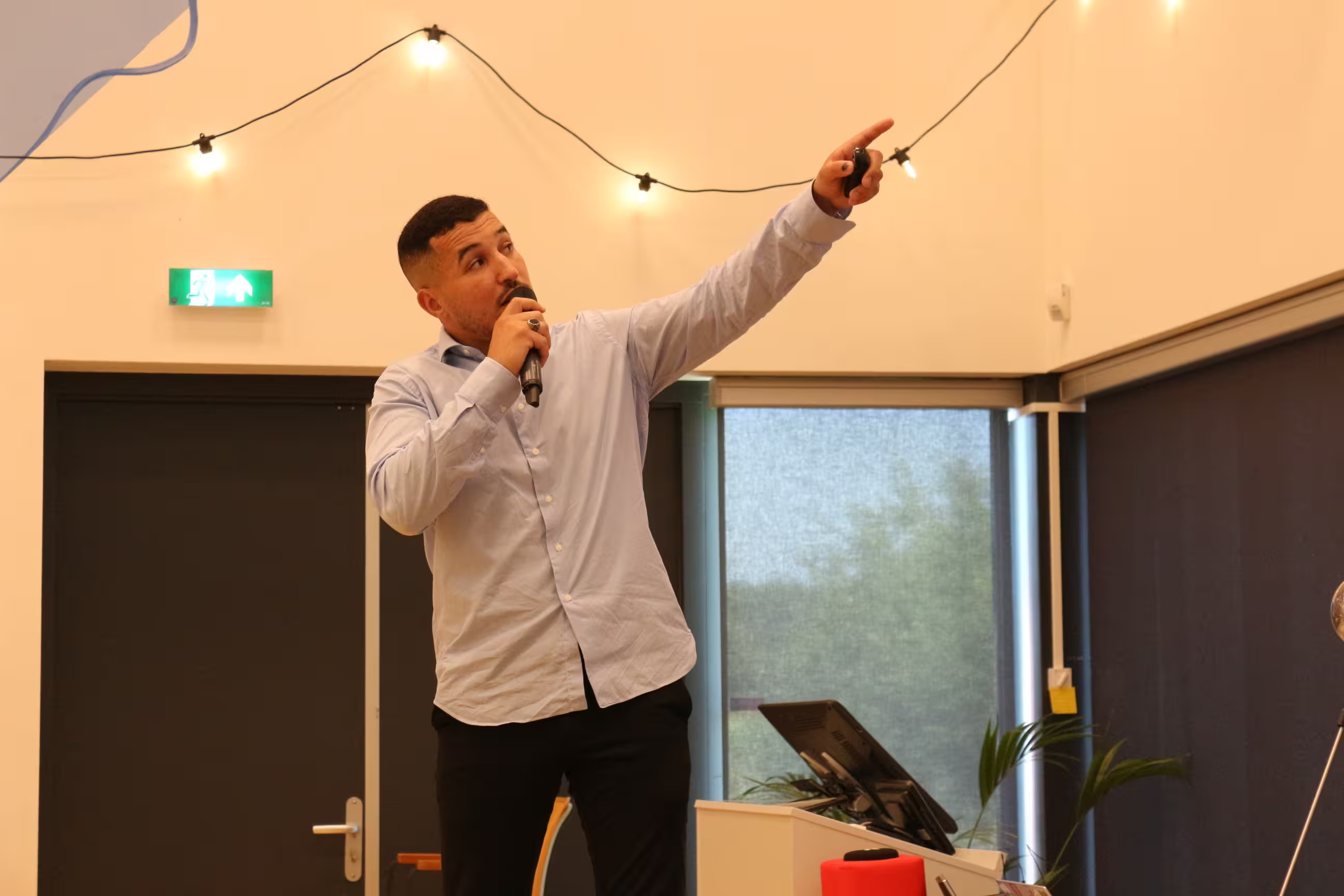
Want to know what investors are really looking for? This AI House Amsterdam interview explores how regional investors evaluate early-stage AI startups and why solving an urgent customer problem matters more than simply building with AI.
The strongest opportunities may come from combining AI with Europe’s existing strengths:
- Manufacturing
- Healthcare
- Robotics
- Sustainability
- Logistics
- Industrial technology
The question founders should ask is not: “Can we build an AI company?”
It is: “How can AI help us solve a problem better than anyone else?”
How Innokite supports the next generation of European founders
At Innokite, we believe technology alone does not build successful startups. People do.
AI creates exciting opportunities, but founders still need:
- Mentorship
- Community
- Customer validation
- Business guidance
- Support from idea to execution
Innokite helps early-stage entrepreneurs transform ideas into scalable ventures and navigate the opportunities shaping Europe’s startup ecosystem.
Because the next generation of European AI companies will not only come from billion-dollar funding rounds. They will also come from founders with great ideas, strong execution, and the courage to start building. 🚀
Ready to build the future? Join Innokite incubator and turn your AI idea into a startup.
FAQs: AI and European startup funding
How much funding did European AI startups raise in 2026?
European AI startups raised US$23 billion in H1 2026.
Why is AI attracting so much investment?
Because AI is moving from experimentation into practical business applications across industries.
Is AI funding spread evenly across Europe?
No. A small number of companies receive a large share of total investment.
Does Europe need to compete directly with US technology giants?
Not necessarily. Europe may have stronger opportunities in specialised AI applications connected to its industrial strengths.
What should founders focus on?
Solving real problems, validating customers, and using AI where it creates genuine value.
News
.avif)